


Bladder cancer is one of the most common diseases. In most cases, the tumor is located on the surface of the bladder, but sometimes it penetrates deeply into the muscle layer. If not given timely attention, the disease may spread to the liver, lungs, and other organs.
It is important to know that after treatment this disease may recur, therefore the patient must always remain under a doctor’s supervision.
The risk of developing bladder cancer increases with age. Its main risk factors are:
• tobacco use;
• working with harmful chemical substances;
• genetics.
What symptoms should we pay attention to?
-
Presence of blood in the urine — this is one of the first and very alarming signals! It may occur with pain or painlessly.
-
Difficulty urinating — burning or pain during urination.
-
Kidney damage — if the tumor blocks the tubes through which urine passes from the kidney to the bladder, the kidney may be damaged due to urinary retention. This causes pain in the lower back area.
In modern uro-oncology, minimally traumatic surgery is considered the “gold standard.” Complete removal of the bladder requires high technological precision.
Although laparoscopy has significantly reduced trauma, it has certain technical barriers:
• Limited mobility: instruments move rigidly and do not have wrist-like flexibility, which complicates work in the narrow areas of the small pelvis.
• Visualization: the surgeon sees a two-dimensional (2D) image, which makes depth perception relatively difficult.
• Hand tremor: the equipment does not completely eliminate the surgeon’s natural hand tremor.
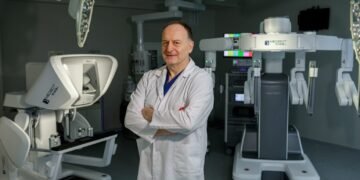
Robotic surgery is a new word in modern medicine. The advantages of this method help the patient make a decision; therefore, over the years, demand for this method has increased.
• The robot’s instruments are more flexible than the human hand (rotate 360 degrees), which allows extremely precise movements where the human hand cannot reach.
• High-resolution imaging makes it possible to preserve nerves and blood vessels to the maximum extent.
• The system completely eliminates hand tremor, making the operation safer.
Robotic bladder cancer surgery, compared to traditional methods, is characterized by:
-
Minimal blood loss, which ensures an almost painless postoperative period.
-
Low risk of infection — small incisions accelerate the healing process.
-
Fast rehabilitation period: the intestines begin functioning quickly, which facilitates the patient’s rapid return to social life.
In conclusion, it can be said that in modern medicine robotic surgery represents the “gold standard.” It makes it possible to completely remove the tumor while maximally preserving the patient’s quality of life and health.